
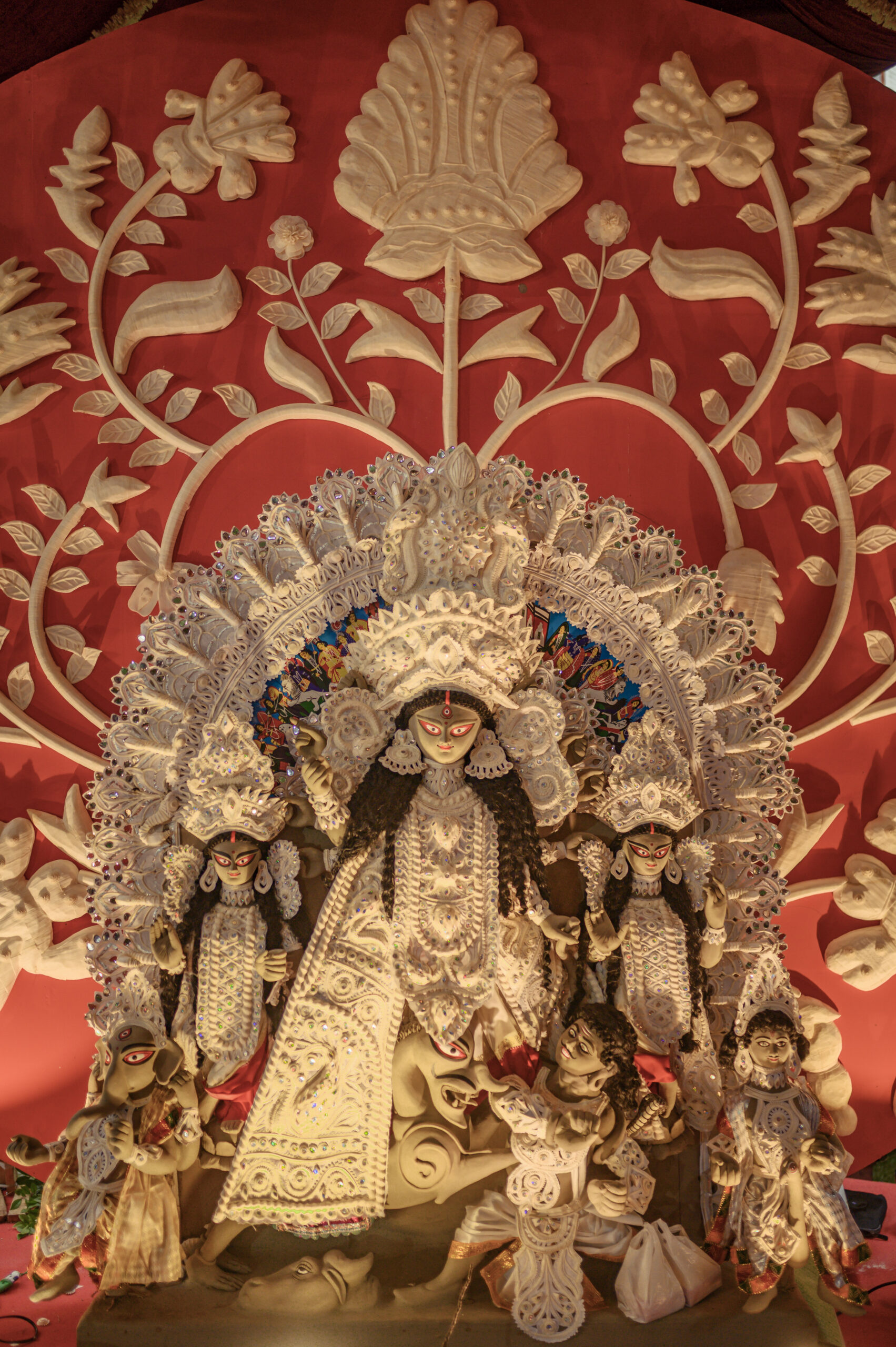
Come Autumn and it is time for one of the most important festivals of the year, Navratri aka Dasara. Also called Dusshera, the festival which celebrates the victory of good over evil is observed with great pomp and glory all over India. While the festivities in the southern city of Mysore are world renowned, Puja celebrations in West Bengal are culturally significant and has been inscribed on the UNESCO Intangible Cultural Heritage of Humanity list in 2021. From larger than life pandals to spectacular lighting and traditional rituals to cultural performance, Durga Puja is an experience in Kolkata and other parts of the state.

As you go pandal hopping in Kolkata, it is hard not to miss the indigenous creativity of the idol makers of Kumartuli who painstakingly craft the magnificent idols of Goddess Durga. One element that is intrinsic to the idols are the intricately carved crown, jewellery and ornaments of the Goddess. It is a pristine white in colour and is often referred to as white gold. This is the native Sholapith craft that has a long-standing place within Bengal’s religious and festive traditions, particularly Durga Puja. So, here are five things you need to know about this indigenous craft

1) The raw material for this traditional handmade craft is obtained from the inner pith of the Aeschynomene aspera aquatic plant (it is also called the shola plant or Indian cork). This central core is soft, spongy and is amenable to carving and hence can be given multiple sculptural and intricate forms.
2) Indian cork grows in the marshy wetlands of West Bengal, Assam, Odisha and a few other parts of Eastern India.

3) The process of extracting the inner pith involves first harvesting the thick stems which are then left to dry. The stems turn brown after which the core is scooped and assimilated into blocks. The latter are then sliced after which artisans use the techniques of dice painting and engraving to turn the pith into beautiful objects.
4) The artisans who work on Sholapith are from the Malakar community in West Bengal. Malakar translates into garland maker and these talented artists craft objects like crowns, boats, ships, idols, jewellery and various other decorative items from the pith.

5) The craft therefore carries significance beyond decoration; it is connected to ritual, craftsmanship and the cultural memory of Bengal. Its white colour symbolizes purity and the material considered highly auspicious for not only Durga Puja but other festivities including weddings. When it appears within a contemporary festive space, it brings with it the memory of the tradition while allowing the visual language to evolve.

Most traditional crafts in India today are dying crafts. Just like all Indian crafts the future of Sholapith depends on keeping them visible, relevant and part of contemporary life. Designers create new contexts for traditional materials without taking away the character of the craft or the skill of the people who make it. Sholapith has such a distinct visual quality that it can hold its own within a contemporary environment while still retaining its connection to Bengal and its cultural traditions.

Click here and here to read about other native Indian crafts.
